Sasha Mia
Some time around noon, the actress gets up to tidy from the night before. 1
The kitchen is (almost) always left messy overnight. It’s a sort of comfort now — a memento mori, a symbol of her errant humanness. Imperfect, but still a hotbed — the source of something alive, although entropic.2 Last night, she’d prepared a proper dinner, which had been plenty of effort. Now, the kitchen is almost tidy, except the counters which still need wiping.
Cleanup is interrupted by the toaster going off.
There’s no butter, cheese, or anything to spread on top; just some perennial margarine left over from baking, and that will have to do.
She casually dreads a trip to the grocery store because it’s time for a “big shop”, which takes a ridiculous amount of energy and is almost as distressing as a “big clean”. The choosing, the carrying, the mental mathematics (buying just the right amount; not spending too much or hoarding so much that anything goes to waste; and enough ingredients for a week or two of simple, flavorful meals).
Two streams of liquid blend mid-air; she holds a pot of jasmine in one hand and a boiling kettle in the other.
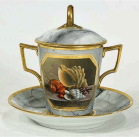
The porcelain cup is dainty: pink, yellow, and blue with painted roses and a gilded lip. Babushka had purchased it for her when they were browsing together at a thrift store. It’s pretty — maybe the prettiest thing she’s ever owned; something she would have never bought for herself, or wouldn’t have thought to before. Now, it’s a reminder that Babushka sees her as the type of “womangirl” who might belong with something so beautiful and delicate. A reminder that — to Babushka — that’s who she is. Despite her temper. 3
She’s managed a great pour. Two streams — one brewed Jasmine tea and the other hot water — meeting together in a delicate china cup. Combined, they create a tea that’s the perfect strength and temperature. A flavor that’s bright and flowery, not at all bitter. And hot, hot enough to create a state change in her, as the best cup of tea must, but not too hot; not too hot that she can’t swallow big gulps. When tea is too hot, she has to wait on it, and in that time, she might get distracted. Then, the tea could go cold, and she’ll start to wonder why she got out of bed at all.4 A few minutes, a few degrees — the chasm between ecstasy and misery.
Since it’s December, she finishes off breakfast with some chocolate-covered gingerbread.
A creamy milk chocolate coat. The German confectioner has baked the cookies into shapes — hearts, stars, and even monks’ praying hands. The actress who hasn’t booked anything recently chooses a heart and a star; some good-luck charms for the day.
The gingerbread is a sweet gesture from Babushka’s Ukrainian home health aid — a terrific, kind, and vigorous woman — “Halina”. She pictures them together, a Ukrainian doctor caring for an elderly Russian immigrant; quite commonplace, yet a discomfiting paradigm of yet another interminable global atrocity.
The sun is shining today.
It’s out of view now, behind the rooftop of her apartment building. Perhaps the dogs will need their walk soon… two massive, shaggy dogs, their black fur everywhere all the time. The great loves of her life.5
She makes them all peanut butter sandwiches for lunch. Hers on toast with some banana slices, the dogs’ portions smushed between large, bone-shaped biscuits. They’re already asleep again, which is a blessing. She enjoys thinking of herself as someone capable of providing a life of leisure, especially for ones as deserving as they are.
The day’s fifth cup of tea shows signs of weakness. She expects that she’ll have to fix a pot of espresso in order to last ‘til the evening’s Zoom meeting.
There’s an unpleasant moment stepping into the shower when she accidentally catches a glimpse of her body in the mirror.
Without time to squint or blur her vision, she is taken aback by bland skin splotched with yellowish-purple and rose pigments, and the unsightly ripples in beige flesh where her backside meets the tops of her legs. She forces her eyes to readjust, and then blinks back at the same nondescript body that’s always been there. She tosses up her too-short long hair and steps into the shower where she scrubs away dead, dirty skin. She feels sort of like an old, grimy handbag; one that’s been tossed into a heap. No — that’s too hyperbolic even for her, with the obvious historical allusions.
Now, she has to entertain more intrusive thoughts about dead Jewish ancestors. Ones who — yes — were starved, hunted, and burned alive. She snaps out of her reverie long enough to think: This is why I can’t possibly be normal, ever.
There’s no way to know when these landmines of brutal and incongruous thoughts will surface; a terror baked into her DNA, which renders horror films and Oscar-bait and news reels all redundant. Seemingly out of nowhere, something else wells up inside her — from her toes and ankles, past her shins, knees, and thighs, and then gathering; a blazing heat in her core.
Oh —
It’s rage…
Hypocrites!
The old, dead Jews.
Their progeny plays victim indefinitely, and as it suits them.
Would they — like the old, live ones — sanction all of the violence and barbarism?
Or were they, too, drawn myopically only to their own persecution?
The “humanwomangirl” turns her face upward to feel the spray of the shower head 6 and says a small prayer of gratitude for the running water, the modern apartment, the appliances that replace hours of labor. She’s the first in her family to live like this — a woman, and alone. It’s a strange American custom, but a luxurious one, for sure.
Her gaze shifts down toward her abdomen and lower extremities, toward what many would argue is a signifying feature, hidden mostly out of view. She wonders how Adolf Hitler would feel knowing that his mustache is a popular style for pubic hair among women.
Stepping out from the shower, the day expands ahead of her again. Water, cleanliness will do that. She dresses in loose-fitting jeans, an oversized button-down shirt, and the wool vest that Babushka crocheted many years ago. The masculine effect of the clothes suits her mood: fearful, but willing to hide it.
It might be the best part of her day, filling the silver percolator.
Piling a small mound of ground coffee and setting the pot onto the flame of the gas stove; time stops and anything is possible. The beautiful scent fills the apartment, and elation fills her. Then, it’s a mad dash to get her lines ready in time. She’s had more than a week to memorize them.
When the time comes to log in to Zoom, her computer screen fills with familiar faces. Tonight, there’s a flurry — everyone has somehow been assigned the same name. A virtual room full of “Vanessa”s feels disorienting, like a strange family reunion. Patricia remarks that this meeting has become in and of itself a sort of play — her sweet face gargantuan, inches from her computer’s camera. They all chatter away while renaming themselves from inside their tiny cells.
Once upon a time, it was an acting class. Now, it’s become a sort of support group; a cradle to hold them while they wait to hear back about jobs.
Even after the initial chaos of this week’s parea recedes, everyone is still out of sorts. Some discuss ideas for projects; all achronological, random, and haphazard, such as the interiors of their minds. And they are so apologetic, the women, the unrestrained femininity of their minds on full display; all lateral, expansive, colorful, patchwork. Each section different, yet somehow connected. They are eager to share the discombobulated contents of their minds. On one hand, they’re proud of their intricate and carefully crafted mind-quilts. On the other, a little bashful and self-conscious of their messy quilts-for-brains. The few men sit by; all quiet, patient, a little in awe, and perhaps a bit annoyed.7
Days later, she stares at a word that she had copied into her notebook:
“Rational.”
Might it be the most masculine word?
Like an order —
“Be rational!”
Held aloft, and over all of our heads like a game of “keep away”. Creating enemies out of our tears and our cries for mercy. To ration, to mete things out. To hoard things, to hold them away. It’s certainly one way to go about things and, of course, it has been. For eons.
She wonders, dipping yet another tea bag, if there’s something that supersedes such finiteness. If rationality is the shell that encompasses the great expanse of reality and meaning, then what does the rest of the egg signify?
Now that’s got her thinking about eggs, like the ones inside of platypuses, mallards, quail, chickens. Like the ones inside of her.
A source.
She and all the other silly, quilts-for-brains “womangirls” are the source of so much, yet cannot be the custodians for some unexplained reason. Now she’s thinking about eggs again, and oof —
groceries.8
She’s done it. The “big shop”.
Thirty-three items to hopefully last at least a week.
She cleans out the fridge.
Medal-worthy science experiments tumble into the compost while she makes up her mind about what to have for supper; a small-but-meaningful victory. Just today, she heard Aretha Franklin remark in an interview that the greatest challenge was deciding what to make for dinner each night. As a kind of reply, the “humanwomangirl” hums a familiar tune: “who am I to blow against the wind…”9
And, later, on the phone with Babushka:
“Ti sevodnya bila na ulitse?”10
“Da, Galya vivela menya na ulitsyu, i mie gulyali…tak horosho dishalos–”11
“Nu i shto, ti syela ves svoy uzhin?”12
“Da, ya vsyo, vsyo syela. Ya pai-devotchka!”13
For dinner the dogs get grilled chicken atop their kibble. The humanwomangirl grates cucumber, minces garlic, and presses a lemon while they listen to second-hand LPs they’d rescued from record store dollar bins.14 She warms up Naan and fresh greens, and tops it with a drizzle of olive oil and freshly made tzatziki.
They sway and sing along to the music. They pray and light the Shabbos candles. They sense into the oneness with source and howl at the moon; their gaze fixed on nothing except an ever-vanishing horizon.
References:
Andre 300 New Blue Sun
Aretha Franklin “Are You Sure”
Astrud Gilberto “Never My Love”
Bruce Springsteen “Atlantic City”
Dido “Thank You”
Joan Armatrading, “Let It Last”
Nina Simone “Mississippi Goddamm”
Paul Simon “I Know What I Know”
Van Morrison Wavelength
Simple Tzatziki:
Shred cucumber
Mince garlic
Fold in yogurt
Add salt, pepper, lemon juice, dill
Stir, and drizzle with olive oil.
Enjoy!
- Andre 3000, New Blue Sun
- Bruce Springsteen, “Atlantic City”
- Aretha Franklin, “Are You Sure”
- Dido, “Thank You”
- Astrud Gilberto, “Never My Love”
- Nina Simone, “Mississippi Goddam”
- Is it envy? Of our softness? The ease with which we access joy? The way we blab and blab and say nothing and everything all at once?
- Joan Armatrading, “Let It Last”
- Paul Simon, “I Know What I Know”
- Did you go outside today?
- Yes, Halya brought me outside, and we walked…the air was so fresh–
- And so, did you eat all of your dinner?
- Yes, I ate it all, all up. I’m a pai-girl!; A Russian colloquialism taken from the Finnish and the Estonian “pai,” meaning “good, sweet” and “girl.”
- Van Morrison, Wavelength
 Wild Garlic